Buying Two Adjacent Plots Instead of One Larger Plot: What Should You Consider?
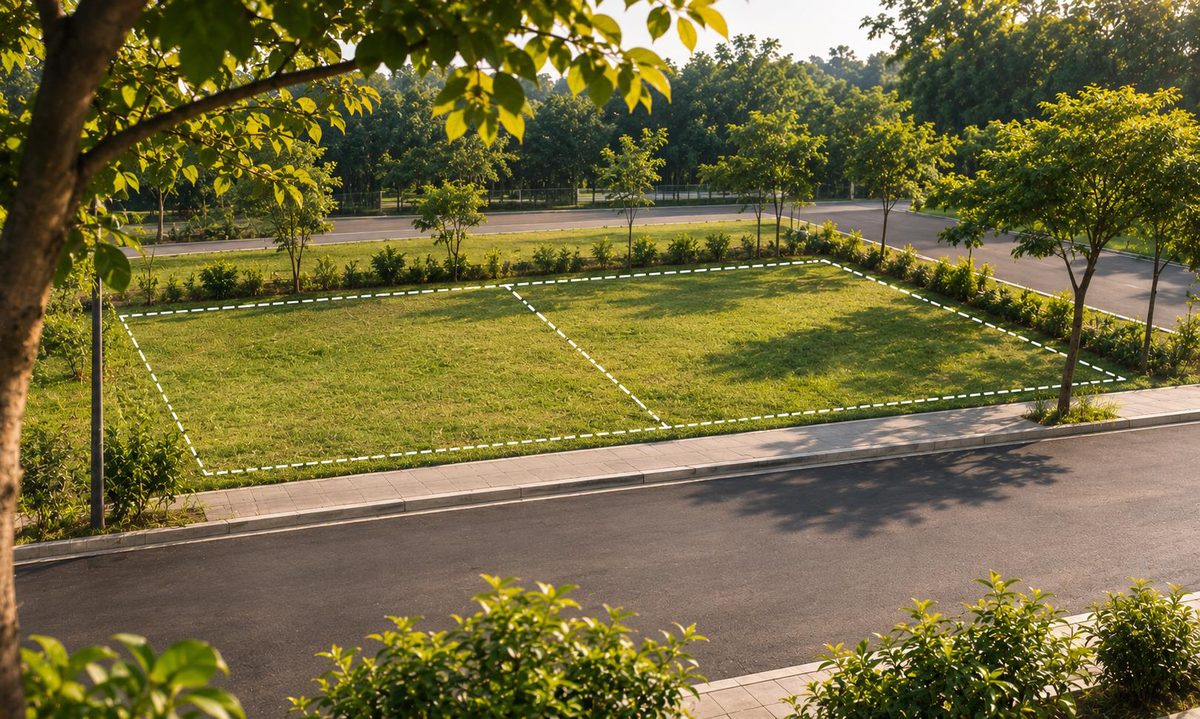
Imagine you're looking for approximately 3,000 sq. ft. of residential land.
You find two options within a plotted development.
The first is a single 3,000 sq. ft. plot.
The second is a pair of adjoining 1,500 sq. ft. plots.
Both offer the same total land area. Both are within your budget. Both are in a location you like.
So, does it really matter which one you choose?
Quite a bit, actually.
While two adjacent residential plots may offer interesting possibilities, they don't automatically function like one larger plot. The difference can affect your house design, construction approvals, ownership arrangements and even how you sell the property in the future.
Before choosing between the two, it helps to understand what you're really buying.
Why Do Buyers Consider Purchasing Two Adjacent Plots?
Not every homebuyer begins with a fixed plot size.
Some start with a broader idea of what they want to build.
Perhaps it's a spacious family villa with a garden. Maybe it's a home with additional accommodation for ageing parents. Or perhaps the buyer wants enough land to build now while keeping some space available for the future.
In these situations, purchasing two adjoining residential plots can seem attractive.
Instead of searching exclusively for one large plot, buyers may consider combining the area of two smaller sites.
For example:
Option Plot Configuration Total Land Area Option A One 3,000 sq. ft. plot 3,000 sq. ft. Two adjoining 1,500 sq. ft. Option B 3,000 sq. ft. plots
On paper, the land area is identical.
However, the possibilities depend on the exact dimensions, boundary alignment, approvals and intended use.
The first question should therefore be whether the buyer wants two independently usable properties or one larger building site.
That distinction influences almost every decision that follows.
1. Can Two Adjacent Residential Plots Be Combined Into One?
This is one of the most important questions to ask before purchasing adjoining plots.
Two properties sharing a boundary do not automatically become one legally recognised building site.
Even if both plots belong to the same owner, they may remain separate parcels in the approved layout, ownership records and relevant property registers.
If the intention is to construct one house across both plots, the owner may need to obtain approval for plot amalgamation or another applicable process.
The exact requirements depend on the relevant planning authority, approved layout, land classification and current regulations.
What is plot amalgamation?
Plot amalgamation generally refers to the formal consolidation of two or more adjoining land parcels into a single parcel for applicable planning or development purposes.
Depending on the jurisdiction, this may involve reviewing the approved layout, ownership documents, survey details and proposed building plans.
The process should not be confused with simply owning two plots under the same name.
Common ownership does not, by itself, establish permission to construct one building across both properties.
Before purchasing adjacent plots for a single home, confirm whether their combination is permissible and what approvals would be required.
This is particularly important when evaluating residential plots in Devanahalli, where the applicable planning authority and development conditions must be established for the specific property.
2. Does Buying Two Plots Give You More Design Flexibility?
Potentially, yes.
But the answer depends on whether the plots can be combined for the intended construction.
Consider two neighbouring plots measuring 30 ft × 50 ft each.
If they share their 50 ft boundaries, their combined outer dimensions could be approximately 60 ft × 50 ft.
That creates a very different configuration from a single 30 ft × 100 ft plot, even though both have a total area of 3,000 sq. ft.
A wider site may provide more flexibility for positioning the entrance, arranging living spaces, planning vehicle access or creating a garden.
A deeper plot may support a different architectural approach, with spaces arranged sequentially from front to back.
Neither configuration is universally better.
What could a wider plot accommodate?
Depending on the applicable building rules and site conditions, a wider plot might offer opportunities for:
- A broader front elevation.
- More flexible vehicle access.
- Living spaces opening towards a garden.
- Greater separation between private and shared areas.
- A courtyard or landscaped outdoor space.
However, these possibilities must be assessed against the permitted building envelope.
If two plots remain legally separate, the applicable setbacks and construction conditions may restrict how they can be used together.
An architect should therefore review the actual approved layout and applicable regulations before the buyer assumes that the combined width is fully usable.
3. How Do Setbacks Work When You Buy Two Adjacent Plots?
Setbacks are the required open spaces between a building and the relevant plot boundaries.
They can influence how much of a residential site is available for construction.
When two adjoining plots remain separate properties, each may be subject to its own applicable building conditions.
If the plots are formally amalgamated, the building envelope may be assessed according to the rules governing the resulting site.
However, the outcome is not necessarily the same in every jurisdiction.
For example, buyers should not assume that purchasing two neighbouring plots automatically allows them to eliminate the setback along their shared boundary.
Similarly, they should not assume that amalgamation will always increase the permitted construction area.
The applicable regulations may depend on plot dimensions, road access, building height, ground coverage, FAR and other conditions.
Why this matters
A buyer might purchase two plots expecting to construct a single large villa across the entire combined width.
If the intended design cannot receive approval, the buyer may need to substantially revise the architectural plan.
This can affect room sizes, circulation, parking and outdoor spaces.
Before committing to a purchase, ask a qualified architect to assess the proposed building footprint and confirm the relevant approval requirements.
4. What If You Want to Build Two Separate Homes?
Buying two adjacent plots may also appeal to families who want to construct separate houses close to one another.
For example, parents and adult children may prefer independent homes while remaining within walking distance.
Two neighbouring plots could potentially support this arrangement, subject to the permitted land use, building approvals and development guidelines.
The advantage is that each home may retain a separate identity and layout.
Families can design the properties according to their individual requirements rather than accommodating everyone within one large building.
However, there are practical considerations.
Each house may require its own approved building plan, access arrangements, utility connections and compliance with applicable construction regulations.
If the properties have separate ownership, the legal and financial arrangements should also be clearly documented.
For buyers planning multigenerational living, it is worth discussing these matters before deciding whether two separate homes or one larger residence would be more suitable.
5. Can You Build on One Plot and Keep the Other Empty?
This is another reason some buyers consider adjoining plots.
They may want to construct a home on one property while retaining the neighbouring plot as open space for a garden or future development.
Conceptually, this offers flexibility.
The family could enjoy additional outdoor space without immediately constructing across the entire landholding.
However, the arrangement should be evaluated carefully.
The second plot remains a separate property unless legally consolidated through an applicable process.
Its use may be subject to the approved layout, development conditions and local regulations.
Owners should also confirm whether any proposed landscaping, boundary treatment, structures or shared facilities require permission.
Think about the long term
If you eventually decide to build on the second plot, will the existing house layout still provide adequate access and privacy?
Would the new construction affect sunlight or ventilation?
Could the two properties continue to function independently?
These questions matter because decisions made during the first phase of construction may limit options later.
Planning both plots together, even if construction happens in stages, can help avoid unnecessary compromises.
6. Is Buying Two Adjacent Plots More Expensive Than One Larger Plot?
Not necessarily.
The purchase price depends on the development, individual plot positions, dimensions, demand and the developer's pricing structure.
Two smaller plots may have a combined price similar to that of one larger plot.
In some developments, particular plots may command different rates because of their road position, orientation, frontage or proximity to open spaces.
However, the land price is only part of the calculation.
Compare the complete cost
When evaluating two plots, consider:
Registration and transaction expenses: The structure of the transaction and applicable charges should be reviewed for the specific properties.
Legal verification: Both plots require appropriate title and document checks.
Amalgamation expenses: If formal consolidation is required and permitted, additional professional and administrative costs may arise.
Architectural planning: A complex site arrangement may require additional design work.
Construction expenses: Building across an approved combined site may involve different structural and service requirements from constructing on one regular plot.
Ongoing charges: Property taxes, maintenance assessments and other charges may apply according to the treatment of each property.
A proper comparison should therefore consider the total acquisition and development cost rather than only the quoted price per square foot.
7. What Happens If You Want to Sell One Plot Later?
One possible advantage of owning two separately recognised residential plots is the potential to sell one while retaining the other.
However, this flexibility depends on how the properties have been used and whether they remain legally and physically independent.
If the owner constructs one building across an amalgamated site, selling part of the property later may require subdivision or other approvals, if permitted.
Even where the plots remain separately recorded, shared structures, access arrangements, utility connections or boundary modifications can complicate a future transaction.
Questions to consider
- Will each plot retain independent road access?
- Can the properties be used separately?
- Are there shared structures or services?
- Would any future subdivision require approval?
- Are there restrictions under the approved layout or development guidelines?
Buyers should not assume that two adjacent plots will always be easier to resell than one larger plot.
Likewise, a single larger plot may have its own advantages for buyers seeking a substantial residential site.
Future market demand, pricing and liquidity cannot be guaranteed for either configuration.
8. Why the Position of the Plots Matters
When buying two adjoining plots, their position within the development can be just as important as their combined area.
Consider the difference between two plots arranged side by side and two plots positioned one behind the other.
Side-by-side plots may create greater road frontage if both face the same road.
A front-and-rear arrangement may present different access challenges, particularly if only one plot has direct road frontage.
Similarly, plots located at a corner, beside a park or near a frequently used internal road may offer different living experiences.
Before making a decision, examine:
- The exact dimensions of both plots.
- The length and position of their shared boundary.
- Individual road frontage and access.
- Orientation and sunlight.
- Neighbouring properties.
- Ground levels and drainage.
- Existing infrastructure and utility provisions.
The combined square footage tells you how much land you would own.
The layout tells you how that land might function.
9. Buying Two Adjacent Plots in a Gated Community
Within a gated plotted development, purchasing adjoining plots may introduce additional considerations.
Developments can have approved layouts and project-specific conditions that govern how individual plots are used.
Before purchasing, ask the developer whether the intended arrangement is compatible with the project's approvals and guidelines.
Questions worth asking
Are both plots part of the same approved residential layout?
Confirm their plot numbers, dimensions and approved land use.
Is combining the plots permitted?
Ask about the relevant authority, approval process and any applicable restrictions.
Can one residence be constructed across both plots?
Do not rely on verbal assurances. Seek appropriate professional and regulatory confirmation.
Will maintenance charges apply separately?
Understand how the development assesses individual plots and whether charges would change following any approved consolidation.
Are there restrictions on boundary walls or construction?
Review the applicable development guidelines.
Can the plots be transferred or sold independently in the future?
Understand how the legal status of the properties and any subsequent construction may affect future transactions.
These questions help buyers understand whether the flexibility they expect is actually available.
10. Two Adjacent Plots vs One Larger Plot: Which Should You Choose?
The right option depends on your intended use.
Consideration Two Adjacent Plots One Larger Plot May remain two separate Ownership Generally one property properties Single large May require amalgamation Subject to applicable building house or other approval regulations Two May offer a practical Separate homes or subdivision may independent arrangement, subject to require specific permissions homes approvals Independent sale may be Sale generally concerns the entire Future resale possible if legally and property unless lawful subdivision is physically separable possible Requires careful Construction Planning depends on the single plot's assessment of the shared planning dimensions and regulations boundary Charges and obligations may Generally assessed according to the Maintenance apply to each property single property's status
Neither option is automatically superior.
If your goal is to construct one large villa, a single appropriately sized plot may offer a more straightforward starting point.
If you want two independently usable properties, adjoining plots may be worth exploring.
If you're considering a phased construction plan, both options should be assessed with your long-term requirements in mind.
The best choice is the configuration that legally and practically supports what you intend to build.
Exploring Larger Residential Plots in Devanahalli
For buyers considering spacious homes or long-term family ownership, plot dimensions and configuration deserve careful attention.
Within plotted developments in North Bengaluru, buyers may encounter residential sites with different frontages, depths, orientations and positions.
At Bulwark Group , our developments in the Devanahalli region offer opportunities to explore residential land for a range of future requirements.
Rather than evaluating plots only by their total square footage, buyers should consider how individual sites can accommodate their intended use.
Those exploring larger landholdings should also understand the difference between purchasing one substantial plot and acquiring multiple neighbouring plots.
A conversation with the developer, followed by appropriate architectural and legal verification, can help clarify the available options.
Explore Bulwark Group's plotted developments in Devanahalli to learn more about our residential projects.
Frequently Asked Questions
Can I buy two adjacent plots and build one house?
It may be possible, but owning adjoining plots does not automatically permit construction across their shared boundary. The proposed development must comply with the applicable planning regulations, and plot amalgamation or other approvals may be required.
Is plot amalgamation compulsory for constructing one villa across two plots?
The requirements depend on the relevant authority, approved layout and proposed construction. Buyers should confirm the applicable approval process before purchasing land for this purpose.
Can I purchase two plots under one name?
A person may be able to purchase multiple properties under the same ownership, subject to applicable laws and transaction requirements. However, common ownership does not automatically combine the plots into one legally recognised building site.
Can I sell one plot after combining two residential plots?
This depends on the property's legal status and any approved amalgamation, construction or subdivision. Separate sale may require further approvals and may not always be possible.
Is buying two 1,500 sq. ft. plots better than buying one 3,000 sq. ft. plot?
Neither option is inherently better. The decision depends on plot dimensions, road frontage, intended construction, applicable approvals, ownership preferences and long- term plans.
Can two adjacent plots have different prices per square foot?
Yes. Individual plots may be priced differently because of their orientation, road position, frontage, surrounding open spaces or other development-specific factors.
Final Thoughts
Two plots of 1,500 sq. ft. may add up to 3,000 sq. ft.
But that doesn't automatically make them equivalent to one 3,000 sq. ft. plot.
The difference lies in how the land is recorded, what construction is permitted and how the properties can be used over time.
For some buyers, two adjacent plots may provide the flexibility they need. For others, one larger plot may be simpler to plan, develop and maintain.
Before deciding how much land to buy, be clear about what you want that land to do.
About Bulwark Group
At Bulwark Group, we’re redefining real estate through transparency, planning, and infrastructure-aligned developments.
Bulwark Group is a premier luxury villa plots developer in Devanahalli, North Bangalore, specializing in eco-luxury and strategically located plotted developments. Committed to excellence and sustainable living, Bulwark offers visionary investors and homebuyers a unique opportunity to own high-value real estate with long-term growth potential near Bangalore’s airport.
Contact Bulwark Group
Location: First Floor, Door No. 3, Reshma Apartments, 196, near Airtel Office, opposite Kotak Bank, Jayamahal Extension, Bengaluru, Karnataka 560046
Email: enquiry@bulwarkgroup.in
Call: +91 963 282 6555
Interested in investing in North Bangalore?
Speak to one of our advisors and explore current plot availability in our premium communities.
Talk to an Advisor